Our mission
Founding statement · September 2026
The problem1
In 2025, 26% of U.S. adults went without some form of medical care because they could not afford it. Among people earning less than $25,000, that rose to 38%. That same year, 21% of adults reported a major unexpected medical expense, with the median amount falling between $1,000 and $1,999.  Federal Reserve, 2026
At the same time, only 63% of adults could cover a $400 emergency expense entirely with cash or its equivalent. Federal Reserve, 2026
The implication: a medical obligation does not need to be catastrophic to become financially destabilizing.
Where Purple intervenes2
Among working-age adults with private insurance who were paying off medical bills or debt, 46% had unpaid balances of $2,000 or more.  Commonwealth Fund, 2026
KFF estimates that approximately 14 million U.S. adults owe more than $1,000 in medical debt, including about 3 million who owe more than $10,000. Its analysis uses nationally representative 2021 federal survey data.  KFF, 2024
The implication: Purple’s initial $1,000–$20,000 range is evidence-informed. The lower end reflects documented affordability pressure around medical expenses in the low thousands. The $20,000 upper limit is an intentional program boundary, keeping Purple focused on obligations where targeted charitable assistance can materially change a household’s outcome.
The health toll3
Among working-age adults with private insurance who were paying off medical bills or debt, 37% said they had used all or part of their savings to pay medical bills, 30% delayed or avoided needed healthcare, and 68% said their unpaid bills caused worry or anxiety. Commonwealth Fund, 2026
The implication: financial pressure from medical expenses can affect savings, household stability, and whether people seek or continue care.
Review before funding4
In 2024, 45% of insured working-age adults reported receiving a medical bill or copayment for a service they believed should have been free or covered. Fewer than half challenged those bills. Among people who did challenge them, nearly two in five had the amount reduced or eliminated. Commonwealth Fund, 2026
The implication: Purple checks for legitimate financial assistance, corrections, appeals, and discounts before committing charitable funds.
Technology as leverage5
The purpose is simple: lower applicant friction and administrative cost so that a lean organization can responsibly help more people.
The impact6
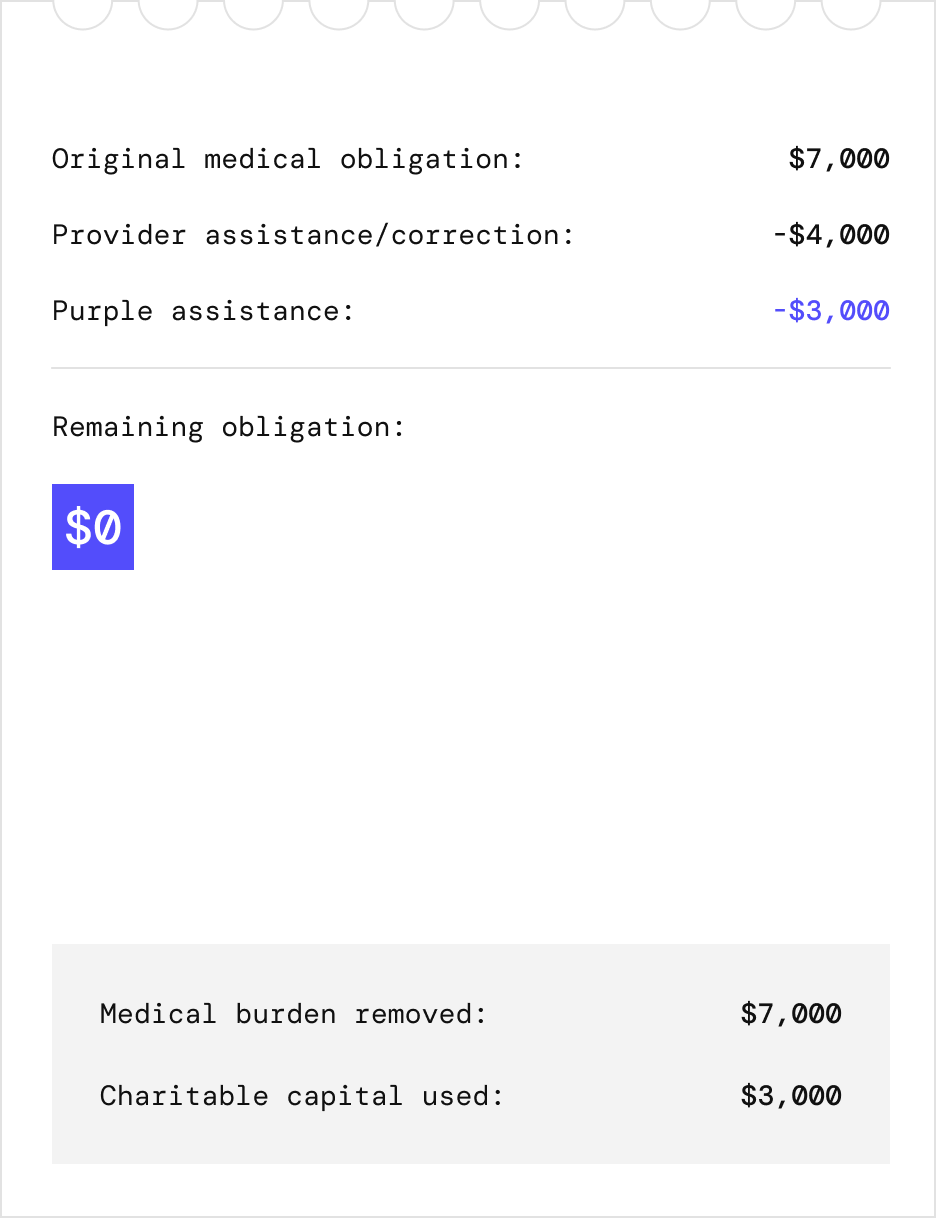
We measure impact in financial hardship removed; not simply dollars transferred to healthcare providers.
36% of working-age adults with private insurance could not pay a $1,000 unexpected medical bill within 30 days.
Commonwealth Fund, 2026This is where Purple makes a difference: We focus on medical obligations large enough to create real hardship, but still within a range where targeted assistance can materially change the outcome. We verify the need, identify available reductions, and direct charitable assistance responsibly.